Minimum Wage
Minimum Wage 2026: Federal Rate, All 50 States, and Your Rights
The federal minimum wage remains $7.25, unchanged since 2009. Check your state's 2026 minimum wage rate and find out what to do if you're being underpaid.
Updated 5 min read PTO Payout Research Team First published
When it comes to minimum wage in the United States, the gap between federal mandates and state realities has never been wider. While almost half of the country saw minimum wage increases take effect in 2026, millions of workers in other states are still bound by a federal wage floor that hasn’t moved in nearly two decades.
If you suspect you are being underpaid, the first step is understanding exactly which minimum wage applies to you. A key practical rule for all US workers: when federal, state, and local minimum wages conflict, employers must always pay the HIGHEST applicable rate.
Here is a complete guide to the 2026 minimum wage landscape, including tipped wages and how to fight back against wage theft.
What Is the Federal Minimum Wage in 2026?
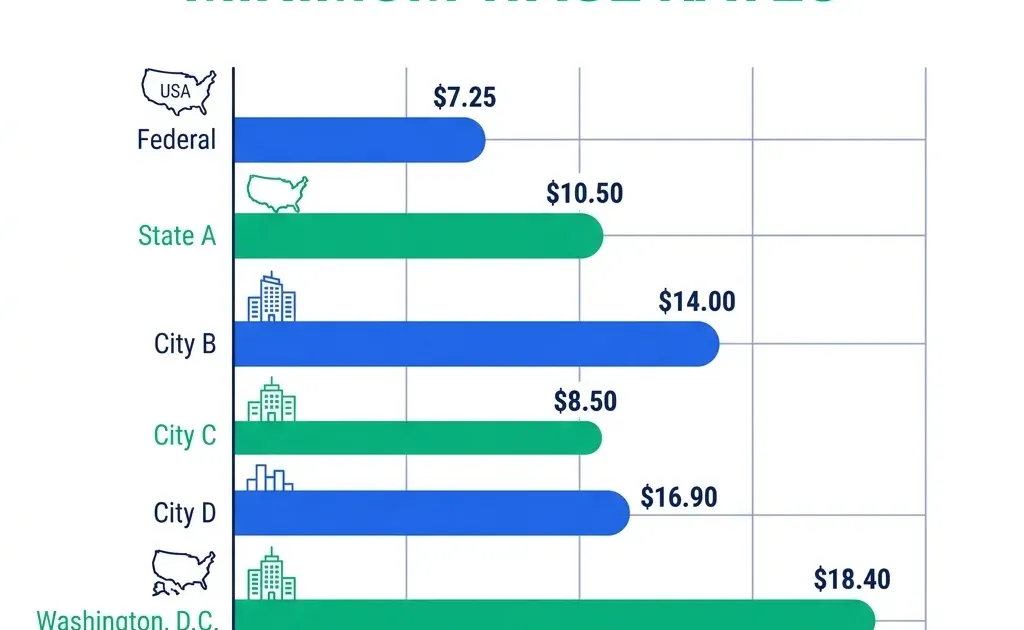
The federal minimum wage in 2026 is $7.25 per hour.
This rate has remained unchanged since July 24, 2009. The 2026 stretch marks the longest period without a federal minimum wage increase since the FLSA created the federal minimum wage in 1938 — now 17 years frozen.
While federal legislation like the Raise the Wage Act has proposed establishing a $17/hr federal floor, it has not passed as of 2026. Because the federal rate has stagnated, state and local governments have aggressively taken over wage regulation.
Which States Have the Highest Minimum Wage in 2026?
Workers in coastal states and major metropolitan areas benefit from the highest minimum wages in the country. Here are the jurisdictions leading the nation in 2026 [3, 4]:
| Jurisdiction | 2026 Minimum Wage |
|---|---|
| Washington DC | $18.40/hr (since July 1, 2026) |
| Washington State | $17.13/hr |
| New York City, Long Island, Westchester | $17.00/hr ($16.00 rest of state) |
| Connecticut | $16.94/hr |
| California | $16.90/hr |
| Oregon (Portland metro) | $16.80/hr ($15.55 standard) |
| New Jersey | $15.92/hr |
Some cities set higher local rates. For example, Seattle’s 2026 minimum is $21.30/hr.
States That Raised Minimum Wage in 2026
If your paycheck suddenly went up in the new year, it might be due to automatic state adjustments. A total of 22 states raise their minimum wage in 2026: 19 on January 1, Alaska and Oregon on July 1, and Florida (to $15.00/hr) on September 30. Many of these increases are tied to inflation or the Consumer Price Index (CPI) to help wages keep pace with the cost of living.
More increases are already scheduled. On January 1, 2027, rates are set to rise in California ($17.40), Colorado ($15.71), Connecticut ($17.48), Maine ($15.70), Michigan ($15.00), Minnesota ($11.87), Nebraska ($15.26), New Jersey ($16.48), Rhode Island ($17.00), and Virginia ($13.75). Alaska is scheduled to reach $15.00 on July 1, 2027, and Hawaii $18.00 on January 1, 2028. Check your state’s current rate.
Tipped Workers: The $2.13 Federal Tipped Wage
For restaurant servers, bartenders, and other tipped employees, the rules are drastically different. The federal tipped minimum wage is an astonishingly low $2.13 per hour (unchanged since 1991).
However, there is a critical federal protection: the “tip credit.” If an employee’s tips plus their $2.13 base pay do not average out to at least the standard $7.25 federal minimum wage, the employer must make up the difference.
Furthermore, several states have eliminated the tipped minimum wage entirely. In these states, employers must pay tipped workers the full state minimum wage before any tips are factored in [2]:
- Alaska (AK)
- California (CA)
- Minnesota (MN)
- Montana (MT)
- Nevada (NV)
- Oregon (OR)
- Washington (WA)
States With No Minimum Wage Law
What happens if your state has no minimum wage law at all? In these states, employers default to the federal minimum wage of $7.25 per hour.
As of 2026, five states have no minimum wage law on the books [2]:
- Alabama
- Louisiana
- Mississippi
- South Carolina
- Tennessee
What To Do If Your Employer Pays Below Minimum Wage
Paying below the applicable minimum wage—whether by shaving hours, misclassifying workers as independent contractors, or failing to make up the tip credit—is considered wage theft.
If you are being underpaid, take these steps immediately:
- Document your hours and pay: Keep your own log of hours worked and take screenshots or photos of your paystubs.
- File a federal wage complaint: You can file a claim with the DOL Wage and Hour Division at dol.gov/agencies/whd. It is completely free, and you do not need a lawyer.
- File with your state DOL as well: State penalties for wage theft are often much more severe than federal remedies. For example, final paycheck laws in some states impose massive daily penalties for unpaid wages.
- Consider an employment attorney: For significant wage theft, an attorney can help you recover back pay plus liquidated damages (often double the amount owed).
Were you underpaid AND denied your PTO payout?
These are both wage theft violations. Use our calculator to see the full amount your employer owes you.
→ Calculate what I’m owed
Sources
What this guide relies on. Laws change, so confirm details with the agency that publishes them.
- Nowsta — Federal Minimum Wage 2026 (opens in a new tab)
nowsta.com Secondary source Accessed June 3, 2026
- Paylocity — 2026 Minimum Wage Guide (opens in a new tab)
paylocity.com Secondary source Accessed June 3, 2026
- Paycom — Minimum Wage Rate by State 2026 (opens in a new tab)
paycom.com Secondary source Accessed June 3, 2026
- Paycor — Minimum Wage by State 2026 (opens in a new tab)
paycor.com Secondary source Accessed June 3, 2026
This guide is general information, not legal advice. See how we source data or report an error.