Benefits
What Is COBRA Insurance? Costs, Rules & 2026 Alternatives
COBRA lets you keep your employer health insurance after job loss — but at $793/month for single coverage. Learn the rules and cheaper alternatives.
Published 5 min read PTO Payout Research Team
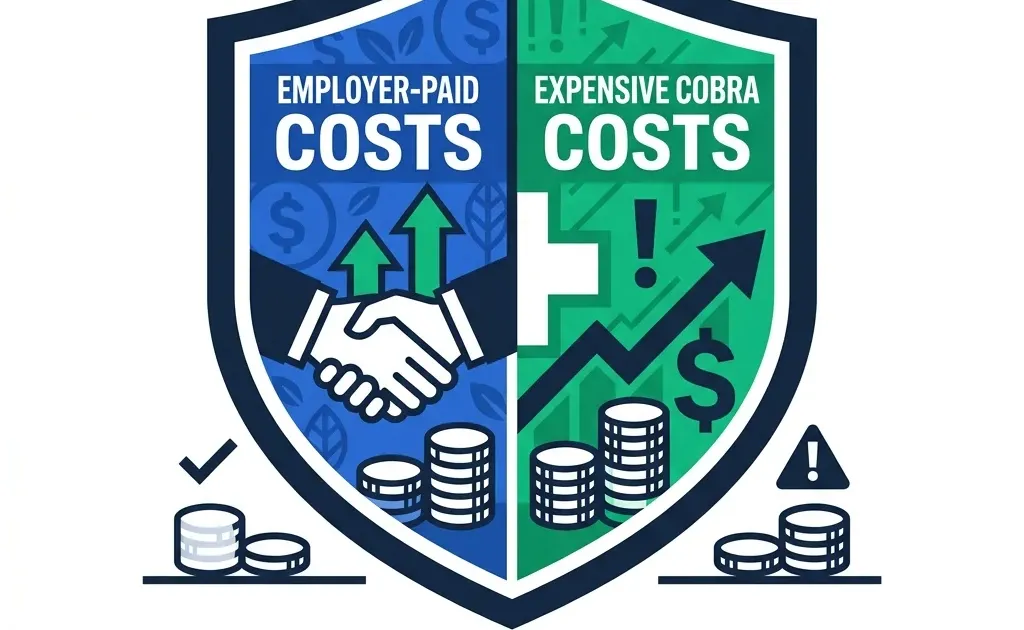
Losing your job usually means losing your employer-sponsored health insurance. To prevent Americans from suddenly losing medical coverage, Congress passed the Consolidated Omnibus Budget Reconciliation Act (COBRA).
COBRA allows you and your dependents to temporarily keep the exact same health insurance plan you had while employed. It sounds like a perfect safety net—until you see the monthly bill.
Because employers heavily subsidize health insurance for active employees, the sticker shock of COBRA is notorious. Here is everything you need to know about COBRA costs in 2026, the strict deadlines, and cheaper alternatives.
What Is COBRA and How Does It Work?
Under the federal Employee Retirement Income Security Act (ERISA), COBRA requires employers to offer “continuation coverage” to employees who lose their health benefits.
If you elect COBRA, nothing about your medical care changes. You keep the exact same plan, the same network of doctors, the same deductibles, and the same prescription coverage. You simply switch from being an active employee on the plan to a self-paying former employee.
Who Qualifies for COBRA? (Qualifying Events)
Federal COBRA rules apply to private-sector employers with 20 or more employees [3]. To qualify, you must experience a “qualifying event” that causes you to lose your health coverage.
Standard Qualifying Events (Up to 18 Months of Coverage):
- Voluntary resignation (quitting)
- Involuntary termination (getting fired or laid off) for any reason other than “gross misconduct”
- A reduction in hours that drops you below the benefit eligibility threshold
Extended Qualifying Events (Up to 36 Months of Coverage):
- Divorce or legal separation from the covered employee
- Death of the covered employee
- A dependent child aging off the parent’s plan (turning 26)
How Much Does COBRA Cost in 2026?
The cost of COBRA is equal to the full premium (both the employer and employee share) plus a 2% administrative fee.
To understand the cost shock, consider the average American worker:
- While employed: Single = ~$114/month out of pocket
- On COBRA: Single = ~$793/month
The jump is 596% more expensive because you’re now paying the massive portion of the premium your employer was secretly covering behind the scenes.
Average COBRA Costs based on KFF Data [1, 2]:
| Coverage Type | While Employed (avg) | On COBRA |
|---|---|---|
| Single | ~$114/month | ~$793/month |
| Family | ~$525/month | ~$2,294/month |
Just lost your job? Don’t forget:
Your PTO payout may be large enough to cover several months of COBRA premiums.
→ Calculate your PTO payout first
The 60-Day Election Window: A Hard Deadline
The COBRA election window is the single most dangerous deadline in the entire job loss process. You have exactly 60 days from the date your coverage ends (or the date you receive your COBRA notice, whichever is later) to elect coverage.
Miss it by even one day and you permanently lose all rights to COBRA continuation coverage for that qualifying event — there are no exceptions and no appeals.
Pro-Tip on Payment Timing: Your first premium is due 45 days after electing COBRA, NOT 45 days after the qualifying event. Because of this, you can theoretically wait until day 59 to elect coverage, pay within 45 days of election, and your coverage will be backdated to day 1 with no gap. This allows healthy individuals to “float” for nearly two months, only electing (and paying for) COBRA retroactively if a medical emergency occurs.
COBRA vs. ACA Marketplace: Which Is Cheaper?
Losing job-based coverage is a qualifying life event that opens a 60-day Special Enrollment Period on Healthcare.gov (the Affordable Care Act Marketplace).
In almost all cases, ACA marketplace plans are significantly cheaper than COBRA, especially because subsidies are based on your current (now reduced) income. However, cheaper premiums often mean narrower networks.
Key decision factors:
- Income: If your projected annual income drops below 400% of the federal poverty level, you are highly likely to qualify for ACA subsidies, making the ACA significantly cheaper.
- Current Medical Needs: If you have ongoing treatments, expensive prescriptions, or specialized doctors currently on your plan, COBRA ensures you keep the exact same network and formulary.
- Timeline: If you expect to find a new job (with new benefits) within 2-3 months, paying a high COBRA premium temporarily may be easier than switching to an ACA plan, resetting your deductible, and switching again a few months later. (Note: You can drop COBRA anytime, but ACA plans run to the end of the calendar year).
- Family Coverage: If you are paying for a family, carefully compare both options. ACA family plans vary wildly in price and network quality.
Mini-COBRA: If Your Employer Has Fewer Than 20 Employees
If your employer has fewer than 20 employees, federal COBRA does not apply. However, do not panic. Most states have enacted “mini-COBRA” laws that force small employers to offer continuation coverage.
Mini-COBRA laws vary widely by state. For example, some states offer 18 months of continuation coverage just like federal COBRA, while others only mandate 3 to 6 months of coverage. Check with your state’s Department of Insurance to confirm your local protections.
Sources
What this guide relies on. Laws change, so confirm details with the agency that publishes them.
- KFF 2025 Employer Health Benefits Survey (opens in a new tab)
kff.org Secondary source Accessed June 3, 2026
- KFF — Average Worker Premium Contributions 2025 (opens in a new tab)
kff.org Secondary source Accessed June 3, 2026
- DOL — An Employee's Guide to Health Benefits Under COBRA (opens in a new tab)
dol.gov Government source Accessed June 3, 2026
This guide is general information, not legal advice. See how we source data or report an error.