Final Paycheck
How to Calculate Your PTO Payout When You Leave a Job
Learn the exact formula to calculate your PTO payout, how to convert a salary to an hourly rate, and how much taxes will take out of your final check.
Updated 6 min read PTO Payout Research Team First published
If you are leaving your job and live in a state that requires employers to pay out unused paid time off (PTO), you might be wondering exactly how much money to expect on your final paycheck.
While the basic math is straightforward, things can get complicated when you factor in salary conversions and tax withholdings. PTO payouts are considered “supplemental wages” by the IRS, which means they are taxed differently than your regular paycheck.
Here is the exact step-by-step formula to calculate your gross and net PTO payout in 2026.
Step 1: Find Your Accrued PTO Hours
The first step is determining exactly how many unused hours of PTO you have in your bank. If your employer provides a single, consolidated PTO bank (combining vacation and sick leave), finding this number is usually as simple as checking your last pay stub or logging into your company’s HR portal (like Workday, Gusto, or ADP).
However, if your employer separates vacation time from sick leave, you must check your state’s labor laws and your employee handbook. Most states that mandate PTO payouts only require employers to pay out vacation time, not sick time. If this is the case, you only count your accrued vacation hours.
Step 2: Determine Your Exact Hourly Rate
If you are an hourly worker, this step is easy: use your current hourly wage. If you get paid different rates for different shifts (e.g., a standard rate and a night differential), PTO payouts are almost always calculated at your “base” standard rate.
If you are a salaried employee, you must convert your annual salary into an hourly rate. The standard calculation used by HR departments across the United States assumes a 40-hour workweek over 52 weeks in a year (which equals 2,080 working hours).
Salary Conversion Formula:
Annual Salary ÷ 2,080 = Hourly Rate
For example, if you earn $60,000 per year:
$60,000 ÷ 2,080 = $28.85 per hour
Step 3: Calculate Your Gross Payout
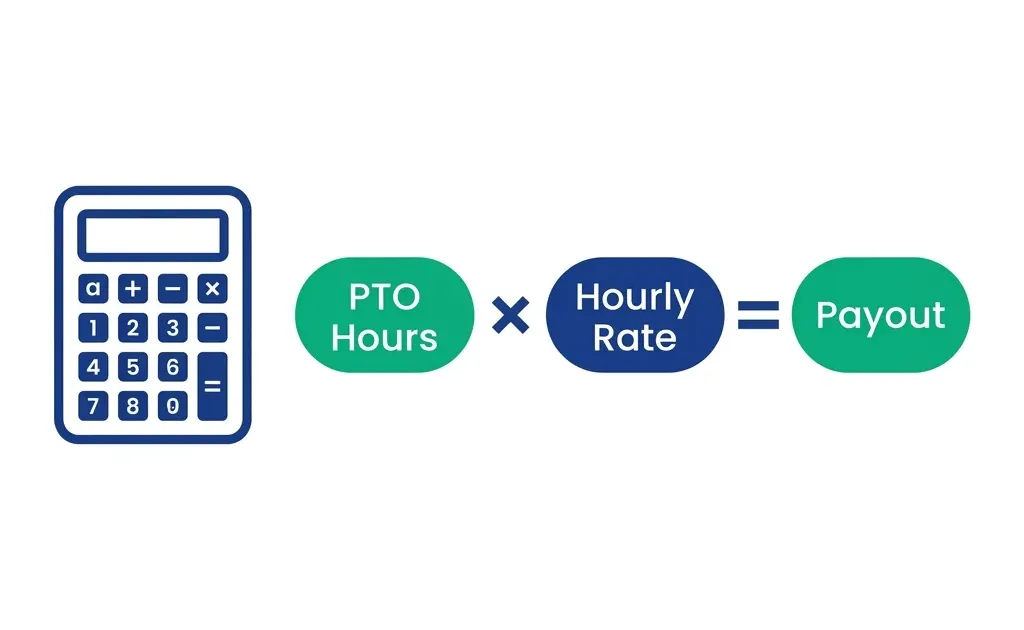
Once you have your total hours and your hourly rate, multiply them together to find your gross payout (the amount before taxes).
Gross Payout Formula:
Accrued PTO Hours × Hourly Rate = Gross Payout
Using our previous example, if you have 80 hours of unused PTO (two full weeks) and earn $28.85 per hour:
80 hours × $28.85 = $2,308
Your employer owes you a gross amount of $2,308. But don’t start spending it yet—you still have to pay taxes.
Step 4: Calculate Taxes and Your Net Payout
Because a PTO payout is often paid as a lump sum upon termination, the IRS categorizes it as “supplemental wages.” Supplemental wages are subject to a different withholding structure than your regular paycheck.
There are two mandatory federal taxes that will be deducted from your gross payout:
- Federal Supplemental Withholding: The IRS requires employers to withhold a flat 22% of supplemental wages for federal income taxes (unless it is bundled with your regular pay and taxed at standard bracket rates, but the 22% flat rate is the most common method).
- FICA Taxes: You must pay standard payroll taxes, which include Social Security (6.2%) and Medicare (1.45%). This totals 7.65%.
Combined, you can expect the federal government to withhold roughly 29.65% of your payout right off the top.
Note: You will also be subject to state income taxes, which vary wildly depending on where you live. For example, if you live in California, expect state supplemental taxes to take another significant chunk. If you live in Texas or Florida, you pay no state income tax.
A Complete Calculation Example
Let’s look at the complete math for our $60,000/year employee with 80 hours of unused PTO:
- Gross Payout: $2,308
- Federal Withholding (22%): -$507.76
- FICA Withholding (7.65%): -$176.56
- Net Payout Before State Taxes: ~$1,623.68
After federal deductions, a gross payout of $2,308 shrinks to approximately $1,624. Depending on your local state income tax rate, your actual take-home pay will likely be between $1,500 and $1,600.
Don’t want to do the math yourself?
Use our free PTO Payout Calculator. Enter your salary, hours, and state to get an instant estimate of your take-home pay.
→ Calculate my exact payout
What If My Employer Refuses to Pay?
If you have calculated your payout and realize your employer has illegally withheld it from your final paycheck, you have the right to file a wage claim.
First, confirm that your state actually requires PTO payouts. You can check our guide on PTO payout laws by state to see the rules where you live. If your state requires it, contact your HR department immediately to request the missing funds. If they refuse, file a formal complaint with your state’s Department of Labor for unpaid wages.
Sources
What this guide relies on. Laws change, so confirm details with the agency that publishes them.
- IRS — Supplemental Wages Withholding (2026) (opens in a new tab)
irs.gov Government source Accessed June 3, 2026
This guide is general information, not legal advice. See how we source data or report an error.